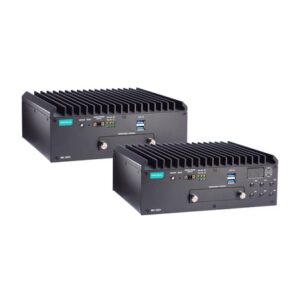
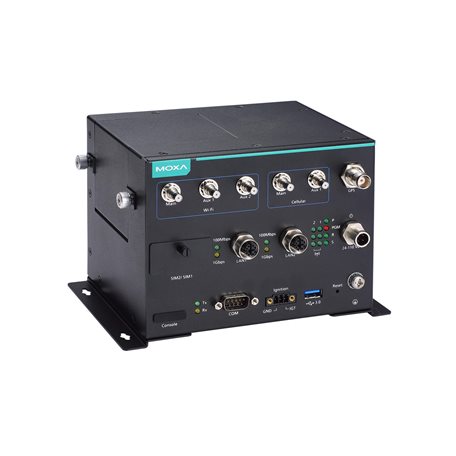
Moxa’s UC-8540 is an innovative computing platform designed specifically for transportation applications. Its single-sided I/O design is ideal for vehicle applications, which typically do not have enough room for installing communication devices. Front-side access makes it easy to install or change SIM cards and wiring cables. Users can install or change wireless modules, mSATA cards, and the RTC battery from the top or the bottom for easy maintenance.
The UC-8540 has 1 miniPCIe slot with USB signal to support a 4G/LTE module, and 1 slot with PCIe/USB signal to support a Wi-Fi module. The 4G/LTE module has two SIM card slots, which can be used to enable redundant cellular network communications or geo-fencing SIM card selection by leveraging the built-in MIRF 2.0, a Moxa device remote-management platform with wireless management.
The UC-8540 can be used as a communication-centric computing platform in applications such as vehicle-to-ground communication gateway, TCMS T2G (train-to-ground) gateway, mobile condition monitoring unit, Ethernet Consist Network T2G gateway, and onboard wireless automated fare collection unit.
The UC-8540 uses an open platform based on Debian 8 with Linux kernel 4.1, allowing solution providers to manage software packages via Debian’s APT (advanced packaging tools), or develop software applications with Moxa’s API Library and GNU C Library.